
Sub-Total: $0.00
Ronald L. DeWald, MD — Pioneer in Spinal Deformity Surgery
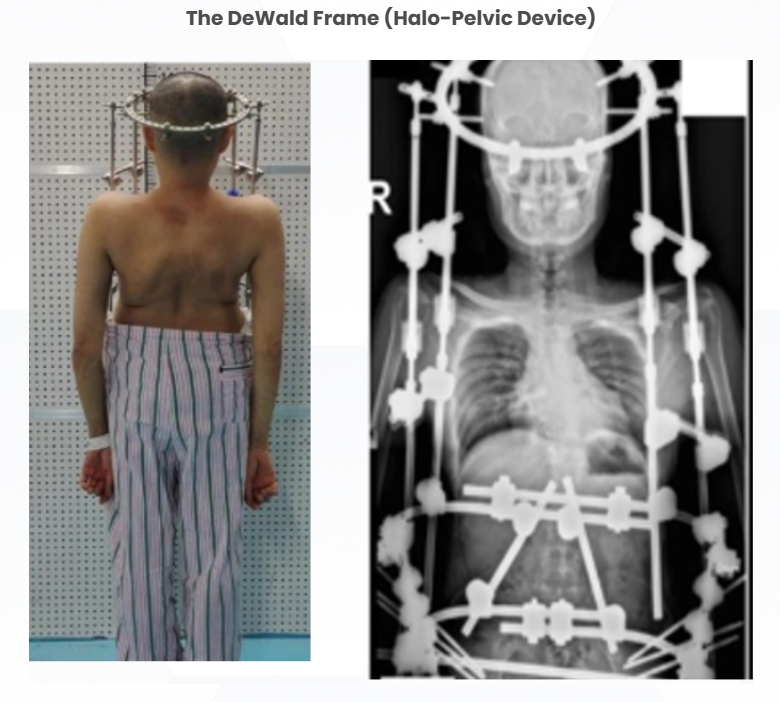
Dr. Ronald L. DeWald was a leading figure in orthopedic spine surgery, known for his work at Rush University Medical Center in Chicago beginning in the late 1950s. He developed the DeWald-Schultz spinal fixation system and the Halo-Pelvic “DeWald Frame,” both of which changed the treatment of severe scoliosis and spinal deformities.
In the 1960s, Dr. DeWald adapted the “Halo,” first used for facial fractures, into a mobile traction system that let patients remain ambulatory during treatment. The device secured a metal hoop to the pelvis with iliac rods and connected it to a cranial halo with turnbuckles. This setup provided continuous spinal distraction, allowing correction while patients could walk and maintain personal hygiene—an important improvement over prolonged bed rest.
Surgical Hardware and Techniques
Dr. DeWald helped move spine care beyond simple bone fusion toward internal and external active fixation systems. He pioneered early instrumentation using screws and rods for spinal stabilization and often used anterior techniques, including the Zielke and Dwyer systems, which relied on cables and screws for realignment. He was also among the first surgeons to combine anterior and posterior approaches to improve correction of rigid spinal curves. The DeWald-Schultz System became a specialized option for complex trauma and severe deformity cases.
Career at Rush University
A founding member and former president of the Scoliosis Research Society (SRS), Dr. DeWald helped shape spinal deformity care worldwide. He served for many years as Professor of Orthopedic Surgery at Rush University, where a professorship now carries his name. His legacy continues through his son, Dr. Christopher DeWald, who leads the spinal deformity division at Midwest Orthopaedics at Rush. In 2012, Dr. DeWald received the SRS Lifetime Achievement Award.
Innovative Techniques and Legacy
Dr. DeWald’s innovations, especially the Halo-Pelvic Frame and anterior instrumentation, set new standards for treating complex spinal deformities. His work reduced reliance on heavy casts and helped advance the acceptance of modern pedicle screw and rod systems, improving stability and supporting faster recovery. His influence reached internationally through fellowship coordination and contributions to spinal deformity surgery education.